












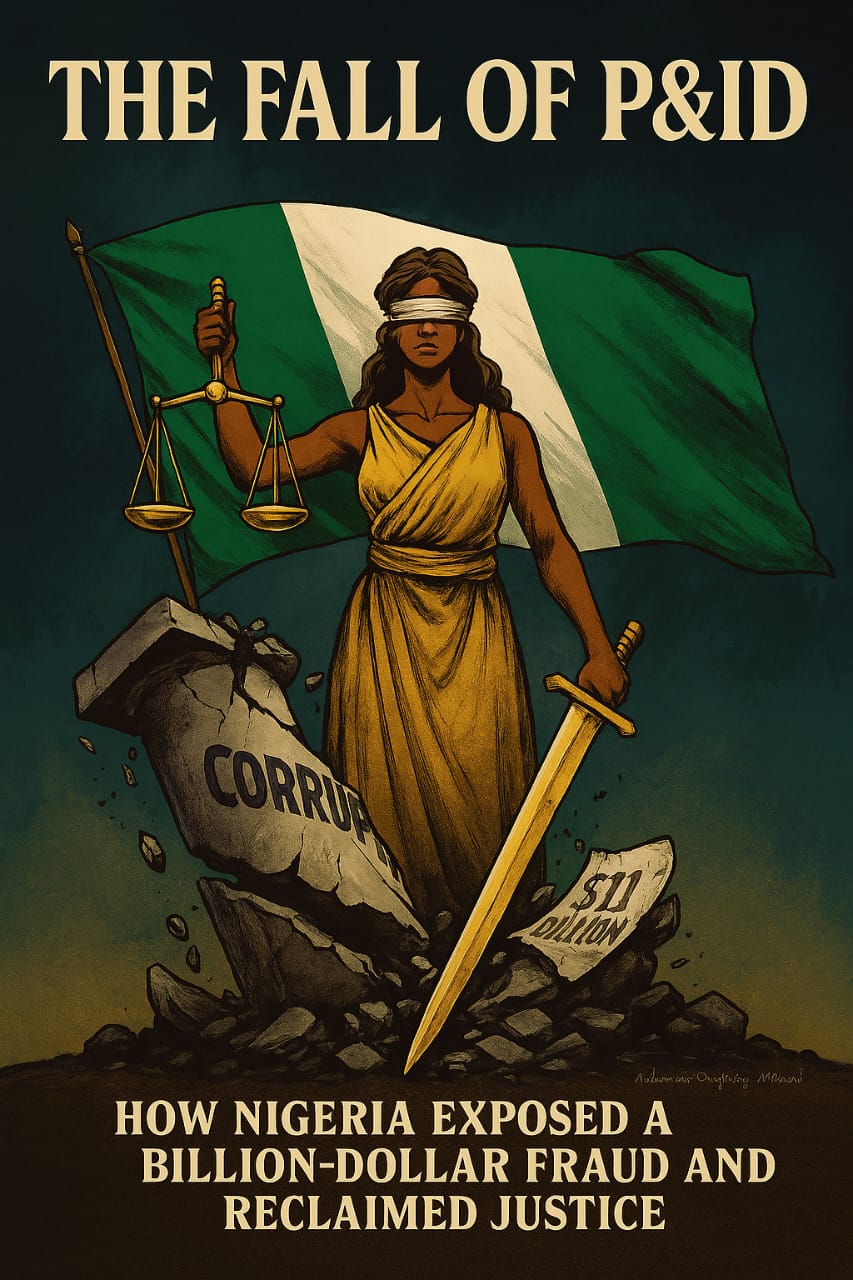
The long-running legal battle between the Federal Republic of Nigeria and Process and Industrial Developments (P&ID) stands as one of the most consequential international arbitration cases in modern history. What began in 2010 as a seemingly routine gas processing agreement between Nigeria’s Ministry of Petroleum Resources and a little-known British Virgin Islands company evolved into a high-stakes courtroom saga involving billions of dollars, layers of corruption, and systemic failure. At its height, the $11 billion arbitration award against Nigeria threatened to cripple the country’s economy, equivalent to nearly one-third of its national budget. But in a stunning reversal, the UK courts exposed the case as a massive fraud built on deceit, bribery, and misuse of the international arbitration system.

At the core of the dispute was the Gas Supply and Processing Agreement (GSPA), under which P&ID was to build and operate gas processing facilities in Calabar, while Nigeria supplied “wet gas” from oil fields. Neither party performed its obligations. P&ID failed to construct the promised facilities or secure financing, while Nigeria failed to provide gas or build infrastructure. Despite the project’s collapse, P&ID took Nigeria to arbitration in London, claiming the government had failed to honour the contract. In 2017, the tribunal awarded P&ID $6.6 billion plus interest, an astronomical sum derived from speculative projections of profits over 20 years. Nigeria’s initial defense was weak and disorganized, but subsequent investigations revealed that the entire agreement had been tainted from inception by corruption and misrepresentation.
The fraud ran deep. UK court findings detailed a web of bribes and secret payments made to senior Nigerian officials to ensure the contract’s approval and to obstruct scrutiny. Grace Taiga, then Legal Director at the Ministry of Petroleum Resources, received cash gifts before and after the contract was signed, influencing her to overlook glaring irregularities. P&ID also misrepresented its readiness, claiming to have spent millions on designs and land acquisition that never existed. During arbitration, the company illegally obtained and used Nigeria’s confidential legal documents, effectively spying on its opponent’s strategy. The presiding judge, Justice Robin Knowles, later described the entire scheme as “industrial-scale fraud” and a cynical attempt to exploit the vulnerabilities of a developing nation.
Nigeria’s persistence ultimately paid off. In October 2023, the UK High Court set aside the $11 billion award, citing overwhelming evidence of bribery, corruption, and perjury. Justice Knowles’ judgment not only vindicated Nigeria but also exposed a troubling flaw in the global arbitration system, its susceptibility to manipulation by unscrupulous actors. The ruling sent shockwaves through the international legal community, prompting calls for stronger oversight and transparency in arbitration involving sovereign states. The UK Supreme Court’s subsequent ruling in October 2025, affirming Nigeria’s right to recover costs in pounds sterling, further consolidated this victory, closing the chapter on one of the most audacious financial scams ever attempted against a nation-state.
Beyond the courtroom, the case has become a lesson in governance, accountability, and institutional reform. It revealed how internal negligence and weak due diligence within Nigeria’s bureaucracy enabled external actors to weaponize the country’s legal and administrative loopholes. The Economic and Financial Crimes Commission (EFCC) has since prosecuted several key figures linked to the scandal, including former officials and foreign intermediaries. Yet, the deeper question remains, how can developing countries safeguard themselves against similar predatory contracts disguised as investment opportunities? The P&ID saga underscores the urgent need for stronger legal expertise, transparent contracting, and stricter anti-corruption protocols in state transactions.
In the end, Nigeria’s victory was more than a legal triumph, it was a moral one. It demonstrated that justice, though delayed, can prevail against powerful interests when pursued with persistence and integrity. The unraveling of the P&ID fraud restored some confidence in Nigeria’s international reputation and signaled a shift in how the world views arbitration involving developing nations. Still, the case leaves a sobering reminder, that corruption at home can be just as dangerous as exploitation from abroad. As Nigeria celebrates this hard-won victory, it must also confront the uncomfortable truth that the seeds of this billion-dollar fraud were sown not in London, but in the heart of its own institutions.
©️ Adebamiwa Olugbenga Michael